
Our Research

Why ABC Futures?
Biodiversity is declining worldwide. In response, countries that are part of the Convention on Biological Diversity (CBD) adopted the Global Biodiversity Framework (GBF) (Secretariat of the CBD, 2023). The framework sets an ambitious goal: to halt and reverse biodiversity loss and to live in harmony with nature by 2050.
One of its most visible goals is Target 3, commonly known as the 30×30 target. This target aims to conserve at least 30% of the planet’s land, freshwater, and marine areas by 2030. Conservation should occur through well-connected and representative Protected Areas (PAs) and Other Effective Area-Based Conservation Measures (OECMs). Importantly, the framework also recognises Indigenous and Traditional Territories (ITTs) as key spaces for conservation (Secretariat of the CBD, 2023).
However, recognition and legal status vary widely between countries. In some places, Indigenous land rights are formally recognised. In others, they remain unclear or contested. Because the GBF refers to ITTs primarily through recognition rather than formal inclusion , their exact role within the 30×30 target remains somewhat ambiguous. Nevertheless, ITTs are increasingly referenced in National Biodiversity Strategies and Action Plans (NBSAPs) and in the GBF monitoring framework , which suggests they will play an important role in future conservation strategies.
ABC Futures explores how these territories can contribute to global conservation goals while supporting the livelihoods and rights of the communities who manage them.
Indigenous Territories and Biodiversity Conservation
Indigenous and Traditional Territories are not new to conservation. In fact, they may represent the oldest forms of area-based conservation in the world .
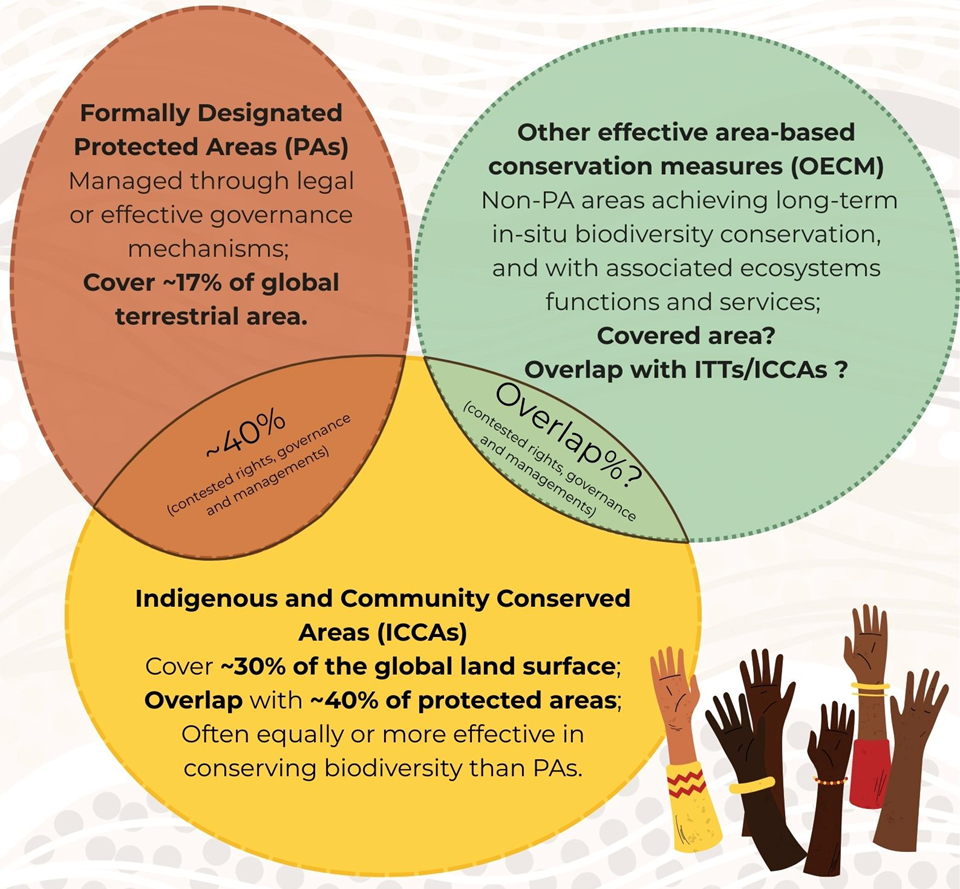
Research suggests that Indigenous countries alone cover approximately 30% of the global land surface (Garnett et al., 2018). These territories overlap with around 40% of formally designated Protected Areas (PAs) worldwide (Figure 1). In many cases, they have been found to perform well as or better than Protected Areas in conserving biodiversity (Jonas et al., 2021; Stevens et al., 2024; Zhang et al., 2023).
Scientific studies show positive conservation outcomes in several areas, including:
- Terrestrial mammal conservation (O’Bryan et al., 2021)
- Protection of intact forest landscapes (Fa et al., 2020)
- Forest structure and ecosystem integrity (Sze et al., 2024)
These findings suggest that Indigenous territories protect a substantial share of the world’s biodiversity (Dawson et al., 2021).
However, ITTs are also under increasing pressure. Major drivers of biodiversity loss include:
- climate change
- logging and mining
- environmental crime
- agricultural expansion
These pressures often translate into social and political conflicts . Globally, Indigenous peoples are involved in more than 34% of documented environmental conflicts , with over 75% linked to extractive industries and land-use change (Scheidel et al., 2023). These pressures threaten not only biodiversity, but also the rights and the livelihoods of indigenous and traditional communities.
Indigenous knowledge and local realities
The conservation outcomes observed in ITTs are closely linked to the knowledge, practices, and worldviews of IPLCs (Levis et al., 2024; Matuk et al., 2019).
These knowledge systems guide land stewardship, resource management, and cultural practices. They shape how communities interact with forests, wildlife, soils, and water systems.
At the same time, many IPLCs face significant social and economic challenges . These challenges may include:
- Limited economic opportunities
- Remote geographic locations
- Reduced access to education and healthcare
- Loss of traditional livelihoods
- Limited pension or social support systems
Environmental pressures often worsen these challenges. Climate change, illegal mining, logging, and hunting can undermine both ecosystems and community wellbeing.
Supporting communities in maintaining, revitalizing, or renewing their knowledge systems can help address some of these challenges (Matuk et al., 2023). At the same time, legal recognition and stronger governance frameworks are needed to address external pressures.

Overlapping conservation systems
Another complexity is the overlap between different conservation designations .
Indigenous territories sometimes overlap with Protected Areas (PAs) and Other Effective Area-Based Conservation Measures (OECMs) (Figure 1). These overlaps can create both opportunities and tensions .
For example, shared conservation goals may encourage collaboration between communities and protected area authorities. At the same time, differences in governance systems or land-use practices may lead to conflicts over land rights, access to resources, or conservation priorities (Stevens et al., 2024).
Furthermore, Indigenous territories are not only conservation spaces. They are also living landscapes where communities pursue livelihoods, cultural practices, and political autonomy. Supporting ITTs therefore requires strengthening local capacities , while also building supportive institutional frameworks similar to those developed for Protected Areas.
Contributions to the Sustainable Development Goals
ITTs make a critical contribution to achieving the Sustainable Development Goals (SDGs).
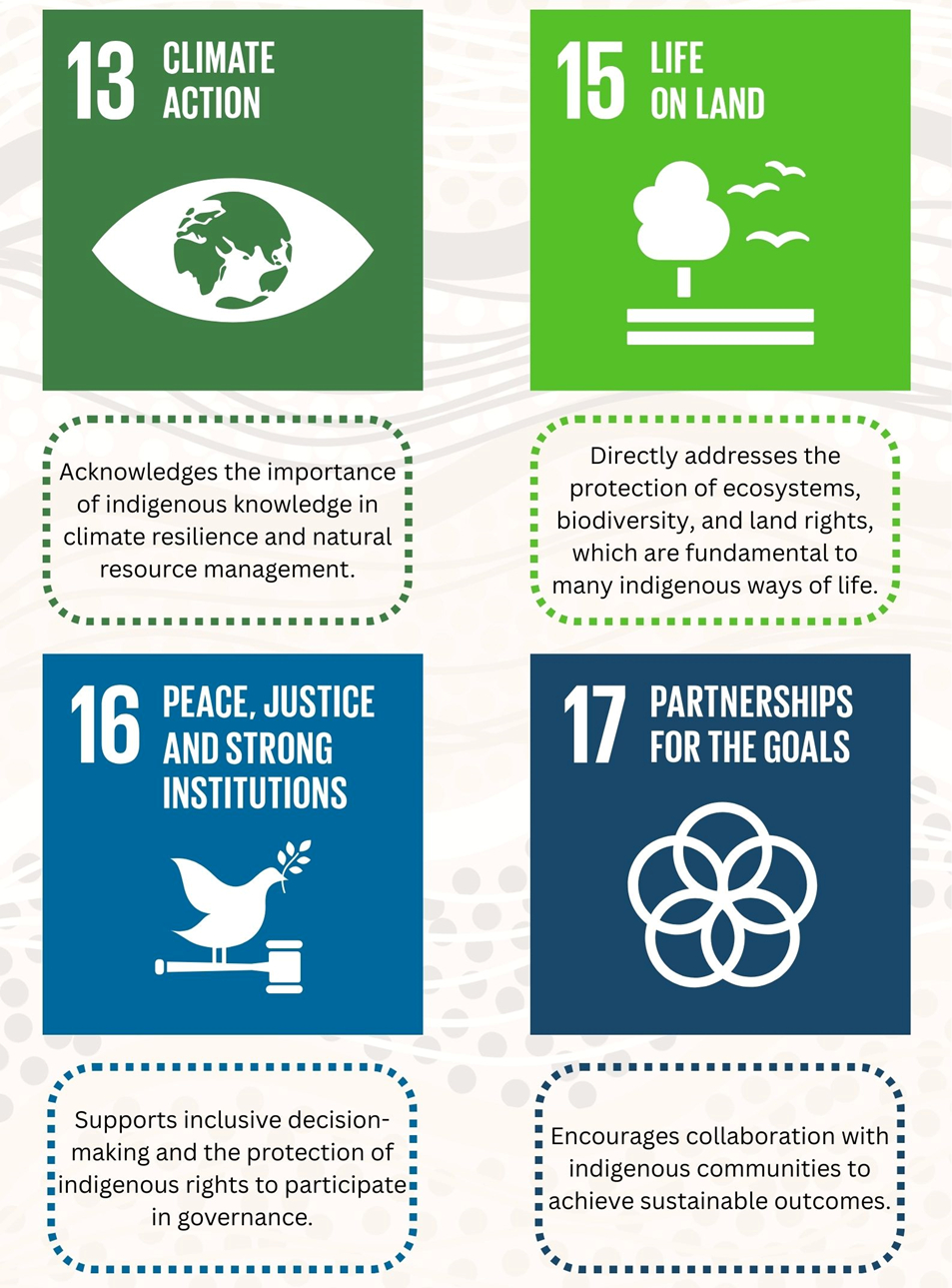
Several SDGs either explicitly or implicitly support indigenous people by promoting social inclusion, environmental protection, and cultural preservation. With biodiversity under indigenous management and governance, indigenous knowledge and values become increasingly important.
Key SDGs that align closely with indigenous rights and biodiversity conservation include (Figure 2):
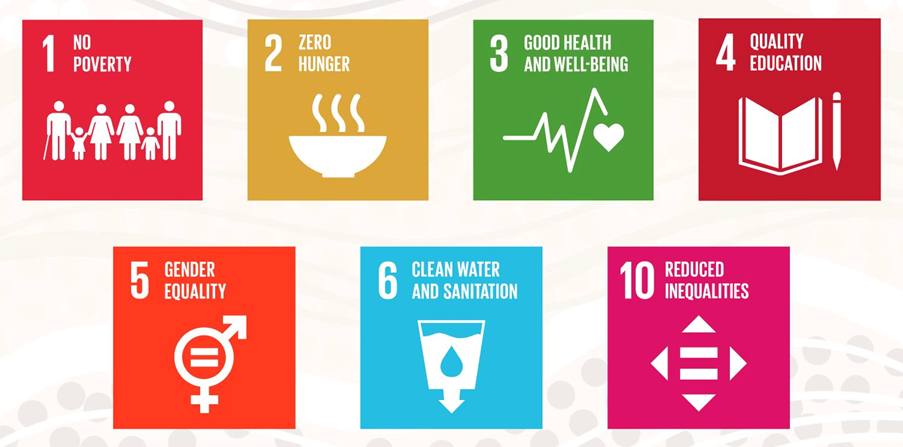
Indigenous territories also contribute to many socially oriented goals, including:
- SDG 1) No Poverty – which disproportionately affects indigenous communities, by ensuring equal access to resources, land rights, and social protections;
- SDG 2) Zero Hunger – which aligns food security and sustainable agriculture with indigenous knowledge systems and traditional farming practices;
- SDG 3) Good Health and Well-being – which addresses the unique healthcare challenges faced by indigenous populations;
- SDG 4) Quality Education – which ensures inclusive education, respecting indigenous languages and cultural knowledge;
The challenge we address
The global diplomatic community adopted the 30×30 target over two years ago , yet its implementation raises important questions.
The ambiguity by which ITTs are made part of the 30×30 target on the one hand and the large promise they hold for biodiversity conservation on the other hand makes them a key subject for study.
PAs are most directly vulnerable to environmental pressures, whereas ITTs suffer disproportionately from the same pressures (Scheidel et al., 2023) as well as from additional pressures that impact their knowledges, practices, and worldviews, as well as their livelihoods and health.
This leads us to ABC Futures main objective:
To explore how ITTs can effectively be part of the 30×30 target while resisting drivers of biodiversity loss – including climate change, expansion of agricultural lands, extractive practices of logging and mining, and environmental crime – and while maintaining, recovering, or renewing their local knowledges, practices, and worldviews.
More specifically, the project explores how ITTs can:
- Resist drivers of biodiversity loss such as climate change, mining, and land-use change
- Maintain or revitalize Indigenous knowledge systems
- Strengthen social and ecological resilience
- Collaborate with other conservation actors
Over the long term, our work aims to support a future in which ITTs become fully integrated into global and national conservation strategies .
Our research approach
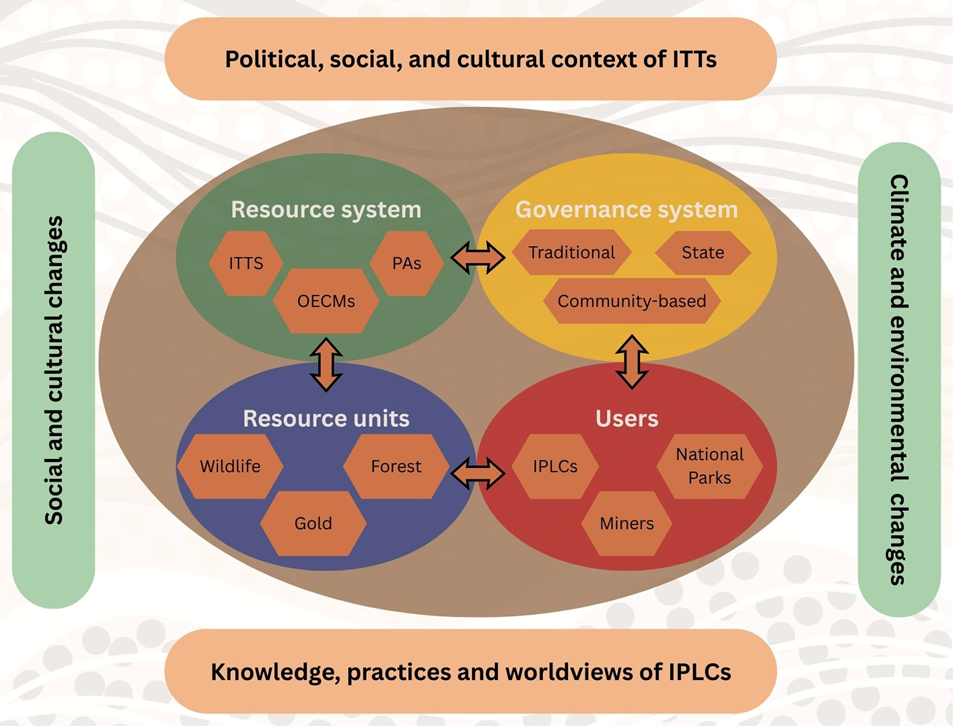
The ABC Futures program uses the Social-Ecological Systems (SES) framework (Ostrom, 2009). This framework helps researchers understand how ecosystems and human communities interact.
The SES framework brings together four key components (see Figure 4):
- Resource systems – ecosystems such as forests, rangelands, or coastal zones
- Resource units – species, plants, wildlife, or other ecological elements
- Governance systems – institutions, rules, and policies that guide management
- Users – communities, stakeholders, and other actors interacting with the system
Conservation outcomes emerge from interactions between these components.
To deepen this analysis, the project combines the SES framework with:
- Ethnoecological approaches (Toledo, 2002; Matuk et al., 2019)
- Critical studies of governance and practices (Behagel et al., 2019; Arts et al., 2023)
- Ecological monitoring and environmental analysis
Together, these methods help us understand both social and ecological dimensions of conservation.
References
Arts, B., Behagel, J., de Koning, J., & Zon, MVD (2023). Community Forest Management: Weak States or Strong Communities? Politics and Governance, 11(2), 336-345.
Behagel, JH, Arts, B., & Turnhout, E. (2019). Beyond argumentation: a practice-based approach to environmental policy. Journal of Environmental Policy & Planning, 21(5), 479-491.
Dawson, N.M., Coolsaet, B., Sterling, E.J., … Rosado May, F.J. (2021). The role of Indigenous peoples and local communities in effective and equitable conservation. Ecology and Society, 26 (3):19. https://doi.org/10.5751/ES-12625-260319
Fa, J.E., Watson, J.E., Leiper, I., … & Austin, B.J. (2020). Importance of Indigenous Peoples’ lands for the conservation of Intact Forest Landscapes. Frontiers in Ecology and the Environment, 18(3), pp.135-140.
Garnett, ST, Burgess, ND, Fa, JE, … & Collier, NF (2018). A spatial overview of the global importance of Indigenous lands for conservation. Nature Sustainability, 1(7), pp.369 374.
Jonas, H.D., Ahmadia, G.N., Bingham, … Dudley, N. (2021). Equitable and effective area‐based conservation: towards the conserved areas paradigm. PARKS: The International Journal of Protected Areas and Conservation, 27.
Levis, C. Resende JS, Barreto JPL, … Biehl J. (2024) Indigenizing conservation science for a sustainable Amazon. Dialogues between Western and Indigenous systems are critical. Science. Vol 386, Issue 6727, pp. 1229-1232.
Matuk, FA, Behagel, J., Schaefer, … Turnhout, E. (2019). Deciphering landscapes through the lenses of locals: The “Territorial Social-Ecological Networks” Framework applied to a Brazilian maroon case. Geoforum, 100, 101-115.
Matuk, F.A., Verschuuren, B., Morseletto, P., … Carvalho, B.L. (2023). Advancing co-production for transformative change by synthesizing guidance from case studies on the sustainable management and governance of natural resources. Environmental Science & Policy, 149, 103574.
O’Bryan, CJ, Garnett, ST, Fa, JE, … & Robinson, CJ (2021). The importance of Indigenous Peoples’ lands for the conservation of terrestrial mammals. Conservation Biology, 35(3), pp.1002-1008.
Ostrom, E. (2009). A general framework for analyzing sustainability of social-ecological systems. Science, 325(5939), 419-422.
Scheidel, A., Fernández-Llamazares, Á., Bara, AH, … & Navas, G. (2023). Global impacts of extractive and industrial development projects on Indigenous Peoples’ lifestyles, lands, and rights. Science Advances, 9(23), p.eade9557.
Secretariat to the United Nations Convention on Biological Diversity (CBD) (2023).
Stevens, S., Eghenter, C., Fitzsimons, J., … & Tabanao, G. (2024). Recognizing territories and areas preserved by Indigenous peoples and local communities (ICCAs) overlapped by protected areas. IUCN WCPA Good Practice Guidelines No. 34. Gland, Switzerland: IUCN.
Sze, JS, Childs, DZ, Carrasco, LR, …Edwards, DP (2024). Indigenous Peoples’ Lands are critical for safeguarding vertebrate diversity across the tropics. Global change biology, 30(1), e16981.
Toledo, V. M. (2002). Ethnoecology: a conceptual framework for the study of indigenous knowledge of nature. In: Stepp, JRFW, Zarger, R. (Eds.), Ethnobiology and Biocultural Diversity. Internal. Soc. of Ethnobio, pp. 511–522.
Zhang, Y., West, P., Thakholi, L., … & Rodríguez-Rodríguez, D. (2023). Governance and conservation effectiveness in protected areas and indigenous and locally managed areas. Annual Review of Environment and Resources, 48(1), pp.559-588.
NEWS & BLOG
- #Conservation, #IndigenousTerritories, #Mozambique
- #Biodiversity, #IndigenousTerritories, #Suriname
- #Biodiversity, #Conservation, #Mexico